
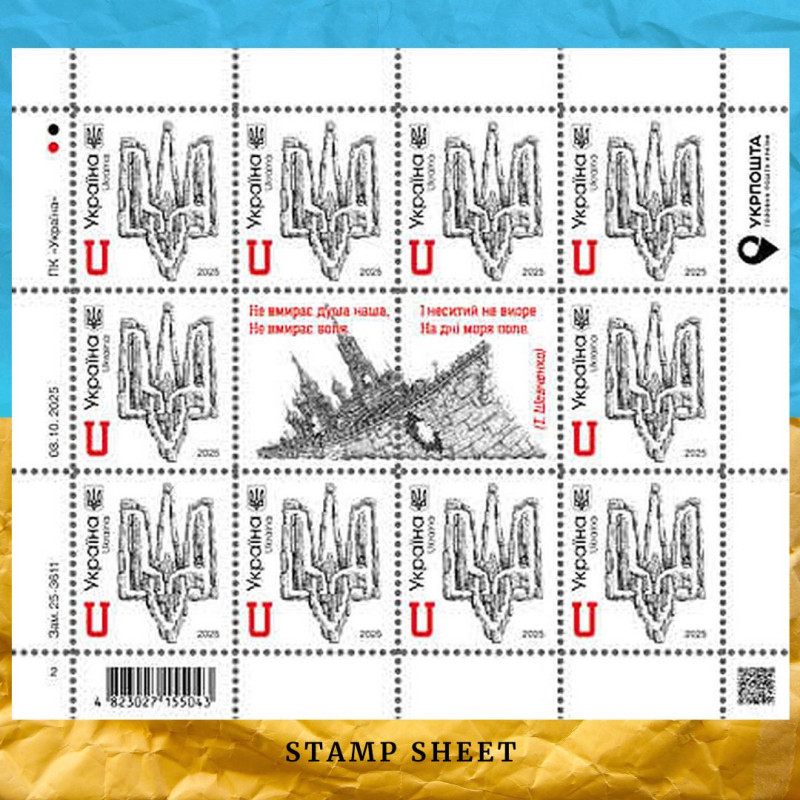
Stamp sheet for the Day of Dignity and Freedom
-
$7.50
| Characteristics of a stamp | |
| Type | not repaid |
| Ukrposhta catalog code | 2210 |
| Subject | National symbols Ukraine |
| Release date | 21.11.2025 |
| Size | stamp size 22 × 24.48 mm sheet size 107 x 91 mm |
| Par | U |
| Circulation | 2,000,000 stamps (of which 23,000 are unperforated) |
I. The Unshakable Emblem of a Nation
There are dates in the history of nations that do not simply mark the passage of time; they become turning points, inscribed not only in human memory but also in the very soul of a people. For Ukraine, the Day of Dignity and Freedom, commemorated each year on November 21, is such a moment. It is a day when personal courage becomes public heritage, when the whisper of liberty becomes a collective voice, and when the will of millions echoes through generations.
To honor this day, Ukrposhta has released a new postage stamp issue — a work of art that speaks in lines more powerful than words. Created by the Ukrainian artist Dmytro Kriushovskyi, this stamp unites three symbolic images: the Trident as the national emblem of Ukraine, the unmistakable silhouette of the sunken Russian warship, and the iconic phrase whose first letter — “Ї” — has already become a cultural artifact and rallying cry of defiance during the Russian-Ukrainian war.
These elements are not arbitrary. They form a visual story of a nation that has endured centuries of struggle, yet has never lost its sense of self. The Trident, with its ancient roots in the princely heritage of Volodymyr the Great, remains not merely a heraldic sign but a living symbol of sovereignty. Its history winds through epochs of Kyiv Rus, periods of foreign domination, and the rebirth of Ukrainian statehood in the 20th century. In the 21st century, under the pressure of invasion and resistance, the Trident has ignited once more as the emblem of unity and heroism—a mark proudly worn on the uniforms of defenders who stand on the frontlines for independence.
The new postage stamp embeds this historical lineage into a modern context. Kriushovskyi’s rendering of the Trident is stylized yet unmistakably strong—its sharp lines rise like the very cliffs of Ukrainian resilience, unbroken and immovable. Beneath it lies the outline of the sunken Russian warship, a reminder of one of the earliest and most iconic moments of the full-scale invasion: the defiant stand of Ukrainian border guards on Snake Island. Their message to the invader was not only a phrase—it became a symbol, a moral verdict, an era-defining statement of dignity. In the stamp, its spirit is represented by the bright red “U,” referencing Ukraine’s indomitable “Україно” and signaling the rise of a new era where national identity is affirmed through courageous action.
This stamp is more than a tiny printed square—it is a visual anthem, a miniature monument that carries the emotions of an entire nation.
II. An Issue Rooted in History and Meaning
The official issue of the stamp “To the Day of Dignity and Freedom” (№2210) enters postal circulation on November 21, 2025. As with all official Ukrainian postage stamps, it becomes a recognized instrument for payment of postage services across all domestic and international routes. Yet its symbolic weight far exceeds its technical purpose.
Technical Specifications:
-
Format of stamp: 22 × 44.48 mm
-
Format of sheet: 107 × 91 mm
-
Sheet composition: 10 stamps + 2 labels
-
Nominal index: “U” (domestic letter up to 50 g)
-
Face value: 20.00 UAH per stamp
-
Print run: 300,000 pcs
-
Printing technique: Offset
-
Design: Dmytro Kriushovskyi
-
Related philatelic items:
-
First Day Cover (FDC) — circulation 20,000 pcs
-
Special cancellations “First Day” in Kyiv and Odesa (Devices №1032, №1033)
-
Philatelic sheet variants (perforated and imperforated)
-
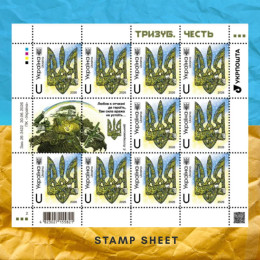
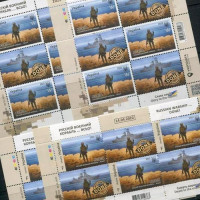
The stamp sheet itself is a visual ensemble. Each row is accompanied by decorative labels bearing inscriptions such as “День Гідності та Свободи,” creating a rhythmic composition across the entire sheet. The margins echo the contrast between black ink and deep patriotic red, reinforcing the emotional impact of the central image.
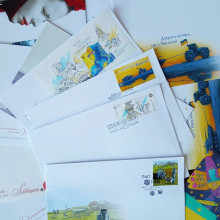
The First Day Cover further expands the artistic narrative. The envelope carries a softer, more contemplative rendering of the Trident, almost as if sketched by the wind over centuries. The commemorative postmark, executed in sharp red lines, displays a vibrating energy—as if the very act of stamping it on paper releases historical memory into the present moment.
Through these philatelic elements, the issue becomes not just an artifact, but a living testament to cultural continuity.
III. A Marked Sheet of Memory and Identity
Every Ukrainian postage stamp carries a fragment of the national chronicle, but some issues rise beyond historical commemoration and enter the realm of collective identity. This is one of them.
The marked sheet (марковий аркуш) emerges as a self-contained artwork. Its design is simple yet powerful, relying not on elaborate ornaments but on clarity and symbolic consistency. The viewer’s eye is immediately drawn to the vertical arrangement of the Trident stamps, each identical yet each somehow unique, standing like soldiers in formation.
Flanking the stamps, the two labels (купони) provide additional interpretive space. They function like poetic footnotes, reminding the viewer that this sheet is not merely a postal product—it is a page torn from the nation’s living diary. The arrangement evokes a sense of order, discipline, and determination, reminding us that dignity and freedom are not abstract values but principles that require daily defense.
In philatelic terms, the imperforated version of the sheet, issued in a limited run exclusively for subscribers of Ukrposhta’s premium philatelic programs, elevates the issue to collector’s status. This variant speaks to the intimate side of philately—the tactile experience of paper, the precision of print, the fascination with variations that carry both artistic and investment value.
Philatelists often say that a sheet without perforations reveals the “pure intention” of the artist. In this case, the uncut edges emphasize the unity of composition, turning the sheet into a single uninterrupted canvas—a symbol of an unbroken nation.
IV. Contemporary Philately and the Spread of National Spirit
To speak about Ukrainian philately today is to speak about more than stamps. Since the beginning of the full-scale Russian invasion in 2022, Ukrposhta has become a global cultural force, transforming postage issues into tools of international communication, resistance, and storytelling. Stamps such as “Russian Warship…”, “Heroic People of Mariupol”, “Good Evening, We Are From Ukraine”, and numerous military-, cultural-, and humanitarian-themed issues have gained global attention.
In this landscape, the stamp “To the Day of Dignity and Freedom” stands as a continuation of this philatelic renaissance. Through artistic expression and symbolic imagery, Ukrposhta spreads the Ukrainian national spirit far beyond the country's borders. Each stamp that reaches Europe, America, or Asia becomes an ambassador of truth, reminding the world that freedom has a price and that dignity must be protected.
Philately today functions as both memory and movement. It preserves the past while actively shaping the global narrative of Ukraine’s struggle and resilience. It allows collectors around the world to touch history, to hold in their hands small fragments of courage printed on paper. It also connects generations—grandparents explaining to grandchildren why a particular stamp appears as it does, parents sealing envelopes addressed to family abroad, soldiers receiving letters from home marked with the symbol of the Trident.
In our digital age, where information flows faster than thought, the postage stamp remains one of the few cultural artifacts that require physical handling, attention, and intention. In this sense, philately becomes almost meditative—an invitation to pause, to observe, to appreciate meaning distilled into miniature form.
Ukrposhta’s mission, therefore, extends beyond postal logistics. It is a curator of national symbolism, a publisher of cultural memory, and a custodian of identity. Every new issue contributes to a larger mosaic of Ukrainian heritage.
V. Artistic Language of Resistance and Renewal
Dmytro Kriushovskyi’s artistic approach lies in the subtle interplay between minimalism and ideological intensity. The Trident is not embellished; instead, it rises stark and proud, almost carved from the stone of ancient Kyiv hills. Its angles are sharp, its silhouette confident—there is no hesitation in its form. The message is clear: even in times of war, Ukrainian identity stands firm.
The sunken silhouette of the Russian warship is rendered with deliberate understatement. It is not the central figure; rather, it sinks quietly into the background. This visual hierarchy serves a purpose. It asserts that the enemy—the invader—plays only a temporary role in Ukrainian history, while the Trident remains eternal. The artist refuses to glorify the aggressor even in defeat; instead, he places emphasis on Ukraine’s endurance and sovereignty.
Finally, the bright red “U” acts as a spark—a burst of emotion, a drop of living blood, a stroke of passion in a monochrome world. It calls to mind the red embroidery of vyshyvanka, the red of the barricades, the red of courage. It reminds the viewer that behind every official symbol lies the beating heart of the people.
The synergy of these three elements creates not merely an illustration but a manifesto. It is a visual declaration of dignity and freedom.
VI. The Anatomy of Symbolism
The technical characteristics of the stamp may seem like dry details, but in philately, they carry deeper meaning. The specific size, the perforation, the printing technique—all these elements affect not only appearance but also interpretation. The compact format (22 × 44.48 mm) forces the artist to concentrate meaning within a narrow visual space. In doing so, the image becomes more intense, almost compressed with symbolism.
The offset printing technique provides clarity and crispness, essential for conveying the sharp contours of the Trident. Meanwhile, the black-and-red color palette draws upon centuries of Ukrainian folk tradition—black for the soil, red for life.
Even the chosen date of issue—November 21—is deeply symbolic. It is the anniversary of both the Revolution of Dignity (2013) and the Orange Revolution (2004). Both events were defined by civic awakening, unity, and the refusal to surrender to injustice. The stamp becomes a commemorative bridge between past and present, linking the long struggle for freedom with the modern fight against aggression.
VII. A Stamp as a Witness of National Transformation
When historians of the future study the cultural landscape of Ukraine during the 2020s, they will undoubtedly turn to postage stamps as key artifacts. These miniature prints will tell a story that cannot be fully captured by textbooks or reports: the emotional climate, the psychological transformation, the metaphors that shaped national consciousness.
The stamp “To the Day of Dignity and Freedom” will stand among them as a witness to a crucial time when Ukraine reaffirmed its identity not through declarations, but through sacrifice and steadfastness. Each stamp, each sheet, each First Day Cover becomes a trace of that era—a piece of evidence that dignity is not an abstract principle but a lived experience.
Philately, in this sense, becomes a parallel archive of national feeling. It records not only what happened, but how a nation felt while it happened.
VIII. Ukrposhta as a Cultural Ambassador
In the international arena, Ukrposhta has become an unexpected cultural ambassador. Its stamp issues are now collected not only by traditional philatelists but by diplomats, journalists, researchers, and supporters of Ukraine worldwide. Some foreign collectors write that they have never before seen a national postal service respond so dynamically to historical events.
Through stamps like this one, the world learns about:
-
Ukraine’s centuries-old struggle for independence,
-
its modern fight against aggression,
-
the values that shape Ukrainian society,
-
the art that nurtures its identity,
-
and the resilience that defines its people.
Every envelope bearing this stamp becomes a message—not only from sender to recipient but from Ukraine to the world.
IX. The Immortal Trident and the Spirit of Freedom
Ultimately, this stamp is about more than imagery. It is about continuity. About a symbol that survived centuries of upheaval, empires, wars, and revolutions. About a nation that has learned to transform pain into strength, history into identity, and identity into dignity.
The Trident rises on this small piece of paper as it rises in the hearts of millions. It stands as a reminder that freedom is not a gift but a responsibility, that dignity is not granted but chosen, and that unity is not inherited but built, day after day.
Kriushovskyi’s artwork captures this truth in the simplest of forms: a proud symbol, a defeated invader, a letter that burns with the fire of a nation’s will.
This is what philately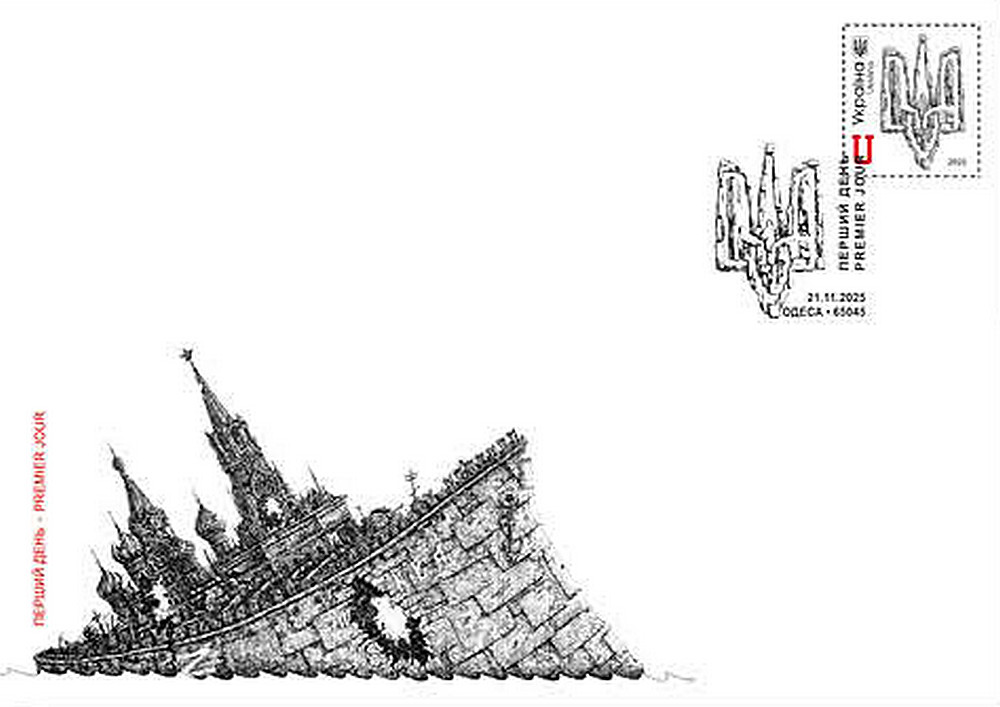 can achieve when it rises beyond collecting—when it becomes art, testimony, and declaration
Related Products
-260x260.jpg "To the 10th anniversary of the death of R. Shukhevich 1960")

Categories

Featured Articles
Ukrainian philately dates back to 1918. By this time postage stamps of Ukraine did not exist largely due to socio-political circumstances: they were destroyed in huge circulations or were exported ..