
Shahy series of stamps

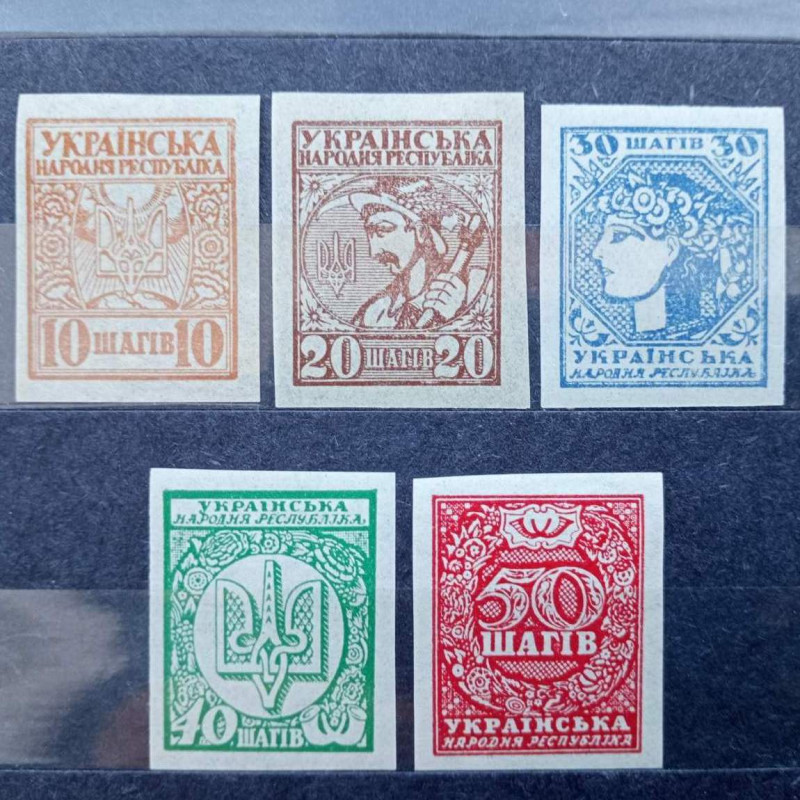
-
$5.50
| Characteristics of a stamp | |
| Type | not repaid with glue without damage |
| Subject | Ukraine national symbols culture |
| Release date | 1918-1920 |
| Perforation | without perforation |
| Par | 10 shahiv,20shahiv,30shahiv,40shahiv,50shahiv |
| Circulation | stamps were printed during 1918-1920 in several printing houses. The total circulation of each denomination exceeds 1,000,000 copies |
First stamps of Ukraine Shahy series of
five stamps 1918
Ukrainian philately dates back to the
declaration of independence of the Ukrainian People's Republic. It was at the
time of state-building that the need for its own currency and postage arose. Although
the UPR's active existence lasted only 5 years, it was enough to create a
strong foundation for today's independent Ukraine.
The founding of Ukrainian philately
It should be noted that the first stamp
issues that can be considered Ukrainian date back to before the formation of
the UPR. However, they cannot be called official because they lack state
affiliation.
The prerequisite for Ukraine's
separation from the Russian Empire was the October Revolution, which provided
for the change of the tsarist regime and the Bolsheviks' coming to power. This
made it possible to set conditions for the formation of a Ukrainian autonomous
republic within the new Russian state. The changes provided for the creation of
new state emblems, including those for postage.
However, the new Bolshevik regime
ignored the demands of the Central Rada and the signing of the relevant
Universal. It expressed its displeasure by attempting to overthrow the
Ukrainian government by force. Having failed in their attempts, the Bolsheviks launched
a campaign to occupy Ukrainian cities, which escalated into the
Ukrainian-Soviet war. The Ukrainian government signed a new Universal, which
proclaimed the independence of the Ukrainian People's Republic.
Both the autonomous and independent UPR
had to create their own state emblems. This led to the need to develop projects
of new postage stamps for their subsequent introduction into circulation. Until
then, the existing stocks of all-Russian stamps were considered valid.
Designing the first stamps
The first sketches for the autonomous
UPR were received on the basis of a competition held in late 1917 and had a
universal design. That is, one cliché sample was used for different
denominations. But with the signing of the Universal Declaration of Independence,
the design had to be redesigned. This was due to the change of the executive
body and the signing of the law on the introduction of a new currency.
Given the course of the
Russian-Bolshevik occupation, the time for holding competitions and discussing
stamp designs was limited. Therefore, the decision was to turn directly to the
artists. The future rector of the Ukrainian Academy of Arts, graphic artist
Heorhii Narbut, led the creation of the first stamps. He was assisted by his
follower Antin Sereda.
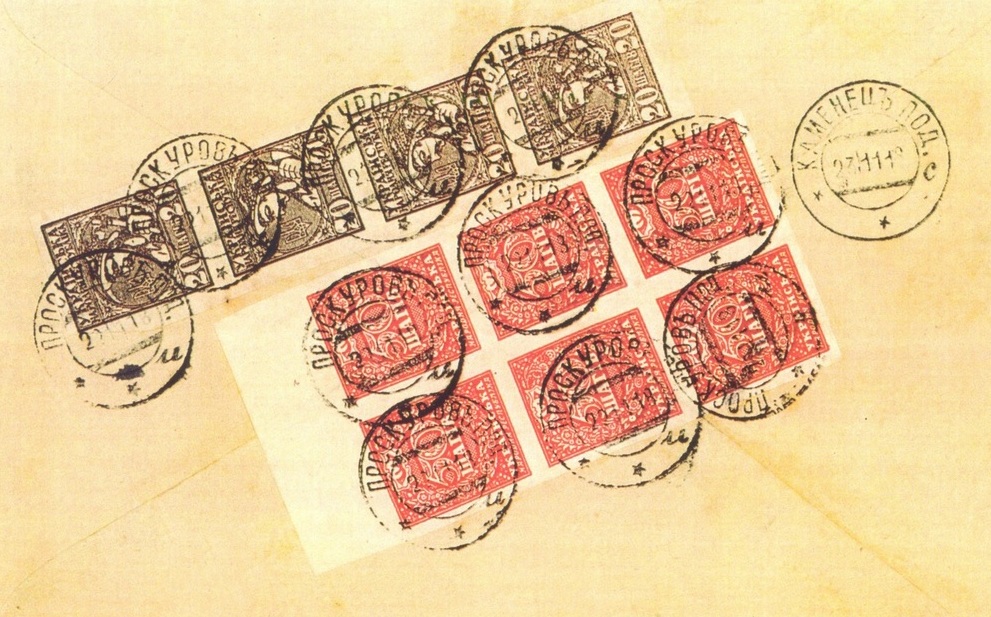
postal item 1918
Description of the shah-stamps by G. Narbut and A. Sereda
It should be noted that the design of
the first stamps and preparations for their issue were faster than the issue of
change coins. Therefore, the authorities decided to issue credit tickets first.
This is how the first stamps-money appeared, which served as a bargaining chip.
They were identical to the developed stamp, but had an overprint on the back in
the form of a rectangular frame with the coat of arms and the inscription
"Walks on a par with a ringing coin".
Prior to the printing of the first
stamps, H. Narbut and A. Sereda submitted proposals for design changes to
distinguish the postage stamp from the money stamps. Artists proposed portraits
of Hryhorii Skovoroda, Kostiantyn Ostrozkyi, and Petro Doroshenko. However, due
to the lack of time to create new clichés, it was decided to issue stamps based
on the existing design of the series. To distinguish them from each other, a
different paper, color shades and the absence of jagged edges were used.
Stamps of 10 and 20 shahs
Sketches for the smallest denomination
stamps were designed by A. Sereda. In philately, it is commonly believed that
if several artists work on a series of stamps, the authorship is given to the
one who designs the smallest denominations. However, it is known that A. Sereda
was a follower and student of H. Narbut.
·
Trident is a stamp with a denomination of 10
steps, which opens a five-value series. The stamp has a classic vertical
orientation. The name of the Ukrainian People's Republic is on the top. The
bottom shows the denomination in the right and left corners with the name of
the currency in between. The center depicts a trident against the background of
the sun, which directs its rays toward the earth. On the right and left sides
is a Ukrainian ornament in the form of flowers.
·
The Kosar has a similar layout with the name of
the republic on the top and the denomination of 20 shahs on the bottom. In the
center is a portrait of a peasant who is depicted with his left side facing the
viewer. He is wearing a shirt and a hat with a woven ear of grain, holding a
scythe with his left hand on his shoulder. His belonging to the Ukrainian
family is confirmed by his loose mustache. There is a place for a trident near
his face.
Both stamps are presented in brown, but
10 shahs are in a light brown shade. The font style of the numerals is similar
to that used on the 1992 kopecks of independent Ukraine.
Stamps of 30, 40, and 50 shahs
denomination
The design developed by G. Narbut is conceptually similar
to the lower denomination stamps, but the artist's style has more details.
Among the features are the use of other smaller fonts. Also, attention to
ornamental decoration and an attempt to add volume to the image.
·
Ukrainka is a stamp with a denomination of 30
shahs, based on a portrait of a Ukrainian girl depicted in the center. She is facing the viewer with the left side
of her face and a wreath of flowers on her head. The portrait is described by
an octagon, the upper part of the faces of which has two tridents on the left
and right. The lower faces are decorated with ornaments. The upper part of the
stamp bears the denomination in the left and right corners, as well as the name
of the currency between them. The bottom indicates that the stamp belongs to
the Ukrainian People's Republic.
·
Trident is a stamp with a denomination of 40
shahs, which is based on a three-dimensional trident in the center. It is
inscribed in an oval with a white background. The periphery of the oval is
decorated with a floral ornament. The upper part of the stamp bears the
inscription Ukrainian People's Republic. In the lower-left corner is the
denomination of 40 shahs, and in the right corner are two crossed postal horns.
·
The half-penny is the largest stamp in the series, with
a 50-shah denomination in the center, framed by an oval wreath of floral
ornaments. The bottom of the stamp indicates the affiliation with the Ukrainian
People's Republic.
Each stamp differs in color. Blue ink and its darker shades were used to make the 30 shahs. The 40 stamps were printed with green ink and the 50 stamps with red ink.
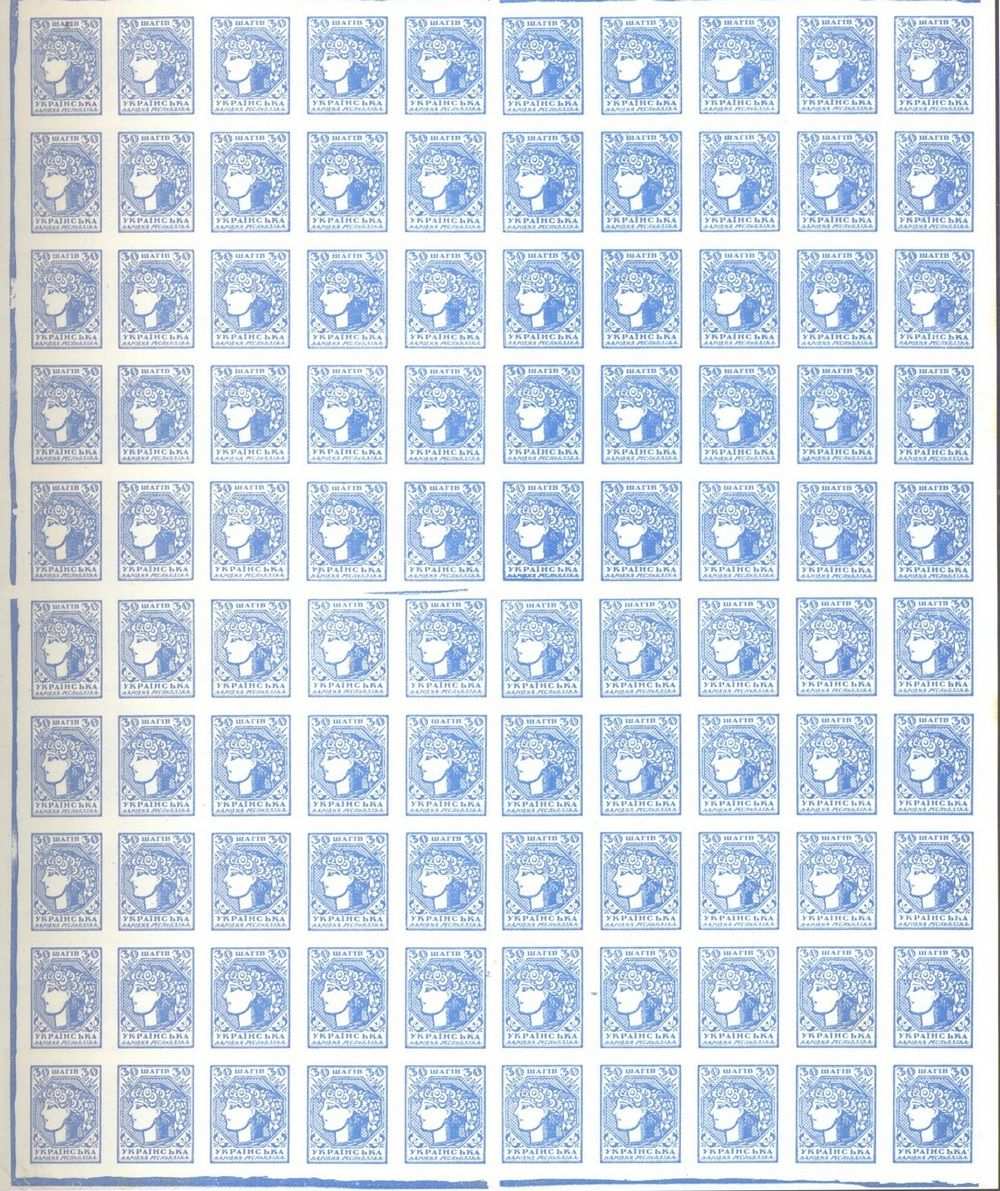 sheet of stamps with a denomination of 30 shahy
Related Products

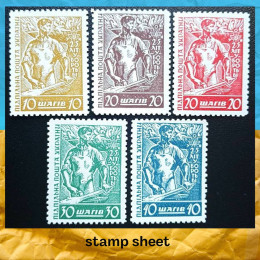
-260x260.jpg "20 years of PPU stamps series of stamps")
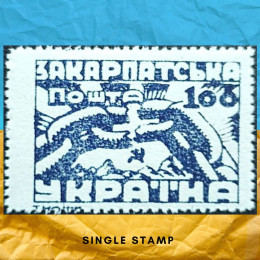
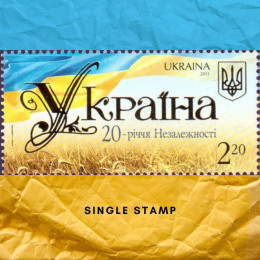
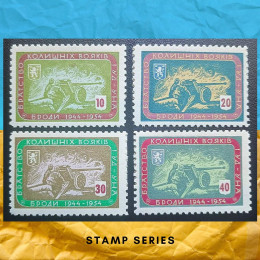
-260x260.jpg "Princess Olga series of stamps (3 stamps without perforation)")
-260x260.jpg "Easter stamp series Underground Post of Ukraine 1960")
Categories
Featured Articles
Nation code - stamps with embroidery of Ukrainian regions.
Fragment of the exposition of the Ivan Honchar Museum..
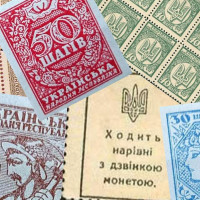
Shahs - the first Ukrainian stamps
ShahsThe Ukrainian state was formed in its first form after the events of the Bolshevik October Revolution. This happened through the proclamation of an autonomous republic within the Russian state ..