
Luboml series of postage stamps
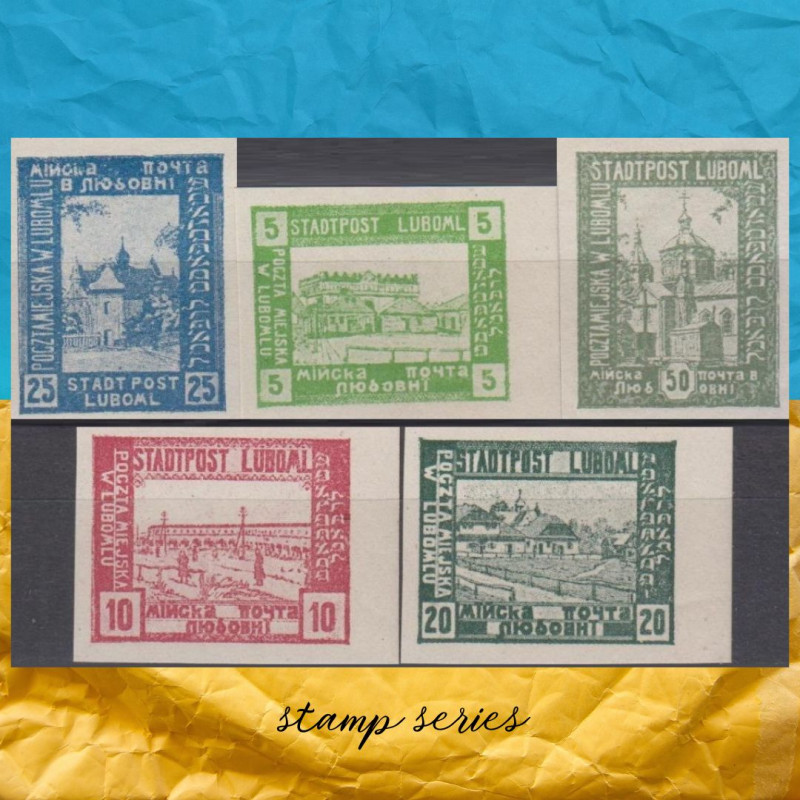
-
$38.00
| Characteristics of a stamp | |
| Type | not repaid stamps of local self-government |
| Subject | cities and regions architectural monuments |
| Release date | 1918 |
| Perforation | without perforation |
| Circulation | 4400 |
Luboml postage stamp series (1918)
What is depicted on the Liuboml series of postage
stamps
The
1918 Luboml postage stamp collection is of great importance to the Ukrainian
philatelic community. These stamps feature a variety of architectural gems and historical
distinctions of the city of Liuboml. Each stamp has its own unique description,
and here is what is depicted on each of them:
1. A
stamp with a denomination of 5. Light green in color, it illustrates a huge
ancient synagogue directed to the east, which was built in 1510. The view opens
from the market square. In the foreground one can see the city's residential
buildings, such as the houses of Samuel Hetman, Yaakov Natanzon, and Broch
Shapiro..
2. A
stamp with denomination of 10. The stamp has a matte carmine hue and depicts
the architectural ensemble of Rynok Square and brick shops built by Hetman
Branytskyi in the late 18th century. In addition, two telephone poles on the
square and the silhouettes of two passers-by are visible.
3. A
stamp with denomination of 20. The stamp is gray in color and depicts the
Catholic Church of the Holy Trinity, located in front of the Shmusl (Manischez
Ginzburg of Jacob and David Kornfracht) house.
4. A
stamp with denomination of 25. The stamp is of a milky blue color and depicts
the same Holy Trinity Church built in 1412. The bell tower, built in 1640,
stands out in the foreground..
5. A
stamp with denomination of 50. The stamp is gray-green in color and features
the wooden Orthodox Church of the Nativity of the Virgin Mary, which was built
in 1884 on the site of an ancient church..
Each
of the stamps has inscriptions. The inscription "Stadtpost Luboml" in
German is located at the top, and the inscription in Ukrainian "MY POSCHA
LUBOVNYA" is located at the bottom. The 50-denomination stamp has another
inscription "MY POSHTA IN LOVE". On the 25-denomination stamp, the
places of the Ukrainian and German texts have been exchanged. The Polish
inscription "Poczta miejska w Lubomlu" is on the left, and the
inscription in Hebrew, שטאָדטפּאָסט לובּאָמל, is on the right.
Today,
the postage stamps of Liuboml of this edition are a valuable collector's item
and deserve to be studied in more detail as part of our national history.
There
are also trial versions of the stamps with denominations of 5 (red), 10
(green), 20 (blue), 25 and 50 (olive). The stamps of this series with the
imprint "Stadtpost Luboml" K and K Etapenpostamt No. 259 or No. I80
were privately produced. These stamps were not put into postal circulation due
to the retreat of Austro-Hungarian troops from the city on November 3, 1918,
and its occupation by the Polish army. All these stamps were sold to philatelic
dealers in Prague.
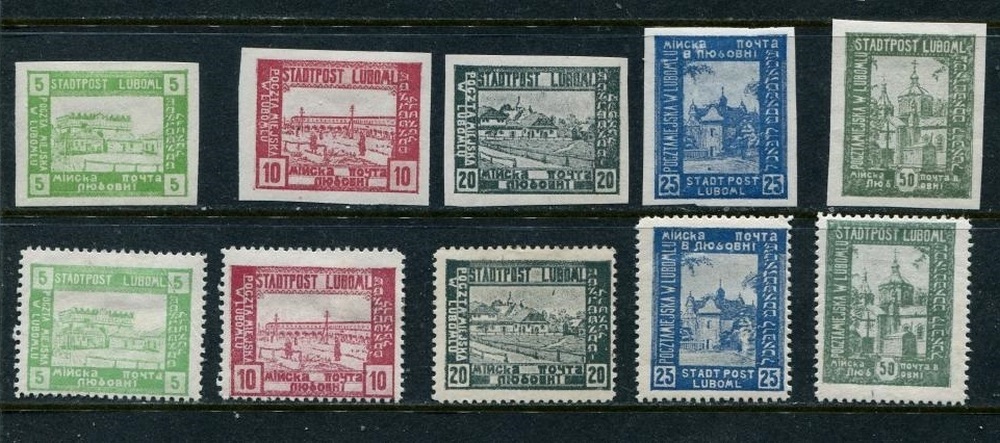
What is known about the stamp series
The
series of postage stamps of Liuboml, issued in 1918, has a fascinating history
of its issue. According to the decision of the Luboml City Council and the head
of the 259th Austrian Stage Post Office, Lieutenant Colonel A. Sternat, a
series of stamps was ordered in September of that year for use among the
civilian population of the Luboml district. The order was placed with the
Prague art and publishing company Union.
The
drawings on the stamps were created on the basis of photographs and were made
by a student of the Prague Art School known as Capri or Caper. As a result,
five stamps of different colors were issued, each of which contained images of
the most interesting architectural structures of the city of Liuboml. The
stamps were 30x24 mm or 24x30 mm in size. The paper on which they were printed
was white or gray-white in color and was either plain or rubberized.
The
series of stamps had two versions - with 11 1/2 teeth and without teeth. The
stamps without teeth were issued in sheets on thin paper. Each sheet contained
11 stamps, leaving one field unprinted. The printing plate was imprinted 11
times on a sheet according to the tet-bache system. The size of the printing
sheet was 180 by 150 mm. Every 11th stamp in the sheet had an inverted face
value.
Today,
the stamps of Liuboml from this series are extremely rare and of great value to
philatelists and historians. They are an important cultural artifact that helps
to reconstruct the historical context and architectural monuments of Liuboml in
the period since 1918. The circulation of stamps with serifs amounted to 6600
series. The number of stamps without teeth was 4400 copies.
Unification through the Post Office: Luboml Stamp Series
The
unique series of postage stamps issued by the city of Luboml reflects not only
the aesthetic beauty of the local landscape, but also a deeper significance of
its historical and cultural significance. These stamps have become a prominent
symbol of the multinational Luboml, where Ukrainians, Germans, Poles and Jews
lived side by side, speaking the four languages reflected on the stamps.
These
stamps were issued at a time when Liuboml was experiencing the brutal trials of
World War I and the Austro-Hungarian occupation. According to the documents,
this series of stamps was issued to restore postal services in the area, which
had suffered significant destruction as a result of the war. However, according
to historians, the stamps played an important role not only in restoring
communications, but also in defining the cultural identity of Liuboml.
First,
these stamps were unique in their multilingual design, which reminded us of the
cultural diversity that existed in Luboml at the time. In particular, the
inscriptions on the stamps were written in four languages: Ukrainian, German,
Polish, and Hebrew, which was unusual in world philately.
Secondly,
they testified to an attempt to unite all the city's national communities
during the trying period of war and occupation. According to historical
documents, this was done through the cooperation of the local administration
and the Austro-Hungarian government, which, under the influence of Ukrainian
deputies from Galicia and the Ukrainian Sich Riflemen, was forced to make some
concessions to the Ukrainian population.
Thus,
this series of stamps turned out to be not just an important historical artifact,
but also a symbol of restoration, solidarity, and intercultural dialogue that
defined Luboml as a multinational city with a rich cultural heritage.
Related Products
-260x260.jpg "Vyhovsky near Konotop series of stamps Podpilna Post of Ukraine 1959 (without perforation)")
Categories
Featured Articles
ShahsThe Ukrainian state was formed in its first form after the events of the Bolshevik October Revolution. This happened through the proclamation of an autonomous republic within the Russian state ..