
Shahs - the first Ukrainian stamps
 Shahs
Shahs
The Ukrainian state was formed in its
first form after the events of the Bolshevik October Revolution. This happened
through the proclamation of an autonomous republic within the Russian state on
November 07, 1917. Later, on January 22, 1918, it was established as an
independent state after the Soviet occupation of Kharkiv and the beginning of
the open Ukrainian-Soviet war.
The Ukrainian People's Republic existed for only 4 years between 1917 and 1921, but it became a solid foundation for today's independent Ukraine. In fact, the government of the republic was in exile from 1920 and transferred its powers to today's Ukraine after the restoration of independence.
Prerequisites for issuing the first
stamps
On the basis of statehood and the
signing by the Central Council of the Third Universal on the autonomy of the
UPR within the Russian state, it became necessary to start circulating
Ukrainian money and postal payment instruments. After all, the post office was
the main communication body between the territorial units of the republic.
Realizing that the existing stocks of postage stamps of the all-Russian
standard would be exhausted, it was necessary to develop the UPR's own postage
stamps.
Designs of stamps of the autonomous UPR
Beginning in late December 1917. the
General Secretariat of Posts and Telegraphs announced a competition for postage
stamp designs, which resulted in 40 stamp designs. Among them, 4 winners were
selected, but unfortunately, information about the authors of the sketches has
not been preserved. The main requirements for the sketch were one design to
create a universal cliché, which simplified the production of stamps of
different values: 5, 10, 15, 25, 35, 50 kopecks, and 1, 3, 5, 10, and 15 karbovanets.
However, this idea was not successful.
Money stamps of the independent UPR
After the Central Council proclaimed the
IV Universal on the independence of the UPR, the General Secretariat ceased to
function as an executive body. It was replaced by the Council of People's
Ministers. The conditions of independence necessitated the development and
issuance of new stamps.
Given the conditions of the
Russian-Bolshevik occupation, the possibilities of holding a competition for a
new design were limited. Therefore, the Council of the Department of Plastic
Arts of the People's Ministry of Education of the UPR turned directly to
artists to produce postage stamp designs. In accordance with the law of the
Ukrainian Central Rada on the introduction of a new monetary unit, the hryvnia,
which consisted of 100 steps, stamps with the corresponding denominations were
adopted. Among the artists' proposals, we selected proposals for postage stamps
with denominations of 30, 40, and 50 shahs by Heorhiy Narbut and stamps with denominations
of 10 and 20 shahs by Antin Sereda.
Narbut was a famous Ukrainian graphic
artist born in the village of Narbutivka in Sumy region. During the Ukrainian
People's Republic, he headed the Ukrainian Academy of Arts and participated in
the creation of state emblems (banknotes, certificates, postcards, coat of
arms, seals). At the same time, he worked on the creation of the Ukrainian
alphabet.
А. Sereda is a Ukrainian graphic artist
born in the village of Shkarivka in Cherkasy region. He was a student and
follower of H. Narbut. Since 1917, he worked in Kyiv at the General Secretariat
of Public Education of the Ukrainian People's Republic. Later in 1918, he
headed the artistic and industrial department of the Ministry of Public
Education. He was one of the initiators of the National Museum.
However, before the approved stamps were put into print, the issue of change money was an acute one. Since the kopecks had disappeared, the UPR authorities decided to use money stamps. They were printed by the Expedition for the Preparation of State Papers at the rented printing house of the Kulzhenko brothers in Kyiv. They differed from stamps in that they were made of cardboard without glue and had the words "Walks on a par with a ringing coin" printed on the back.
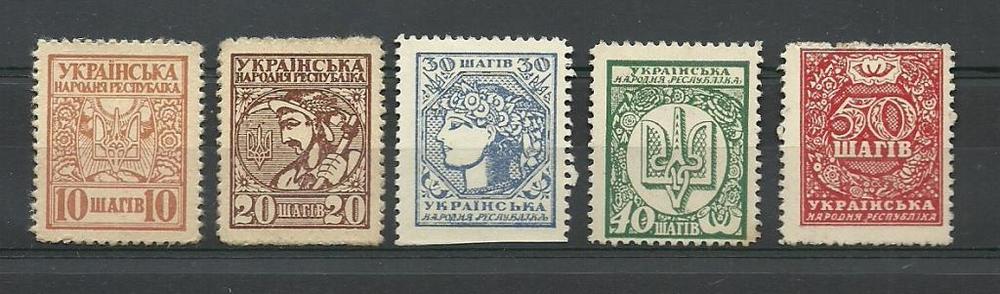
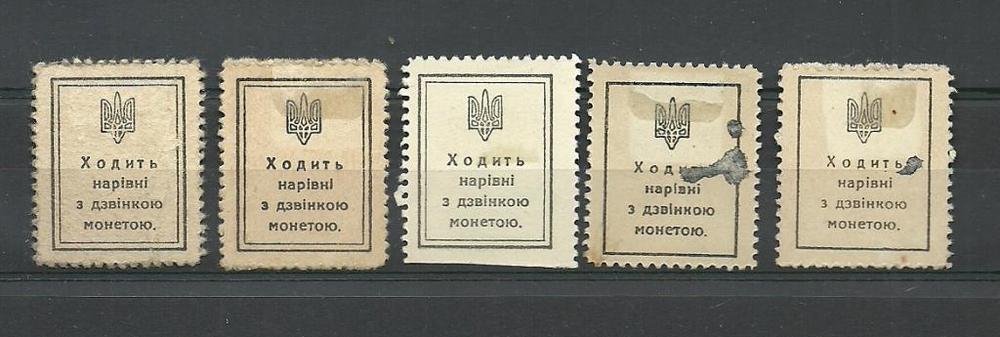
money stamps
The first issued shah-stamps
Initially, the UPR post office planned
to issue stamps with portraits of Hryhorii Skovoroda, Kostiantyn Ostrozkyi, and
Petro Doroshenko. They were also designed by graphic artist H. Narbut, but due
to the lack of time for preparation, it was decided to use existing clichés
from money stamps. Therefore, both editions were produced in the same way on
large sheets of 400 stamps, which were then cut into 4 parts.
The postage stamps were issued at the
same printing house. The design on the stamps did not differ from the first
money stamps. The main differences were the paper, the adhesive backing, and
the absence of serration. There is no official data on the circulation of these
series. It is speculated that the total number of stamps issued reaches
millions.
Despite the fast and well-established
printing of stamps, the postal needs of the independent state could not be met
at that time. For these reasons, the postal and telegraphic department also
used the stocks of tsarist stamps, which were overprinted with the coat of arms
of the Ukrainian state in the form of a trident.
It is also worth mentioning the events
of the anti-Hetman uprising with the formation of the Directorate of the
Ukrainian People's Republic. In early 1919, a 20-hryvnia postage stamp was
issued based on a sketch by the artist Leonid Oboznenko (repressed by the
Soviet authorities in 1937 in Kyiv). No competition was held to select the
miniature. It was based on a draft design that was kept in the Expedition of
State Paper Procurement after an earlier competition in 1917. Only the name
changed from the Ukrainian Republic to the Ukrainian State. The use of such
stamps is known in Podillia and Volyn.
Vienna issues of hryvnia stamps
Given the progress of the Ukrainian-Soviet war and the occupation of Kyiv, the Central Rada was evacuated. However, the government continued to operate from the Polish city of Tarnów. In August 1920, a decree was issued to withdraw all previously issued postage stamps from circulation. A new series of 14 stamps was introduced to replace them. Due to the army's failures at the front and the loss of a large number of territories, the economic system of the UPR was significantly destroyed. This resulted in unlimited issue of banknotes. Therefore, the stamps were designed to have denominations in hryvnia value from 1 to 200. As for the origin of these stamps, at least 6 of them were designed by the artist Mykola Ivasyuk and issued in Vienna. The full run of 100 million of these stamps was never included in the series due to the defeat of the UPR at the fronts.
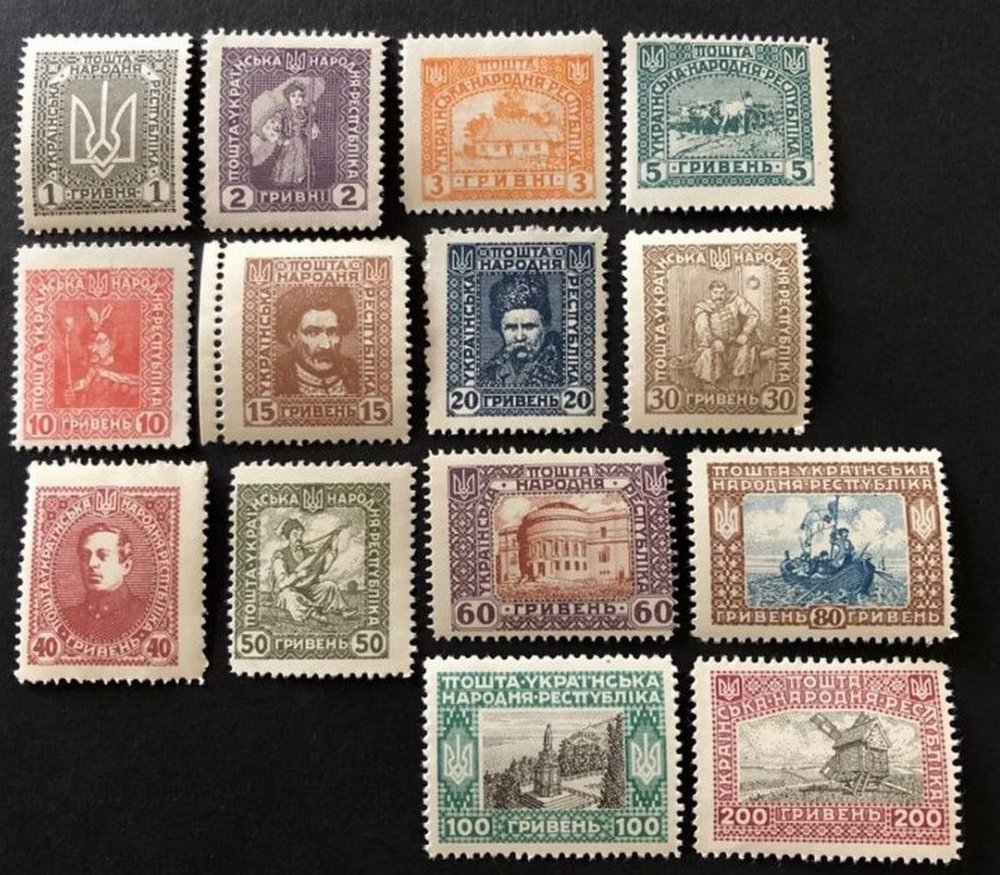 stamps of Vienna issue
Related Products
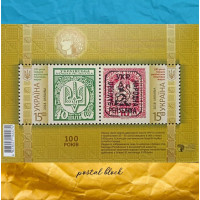
75 Years of Ukrainian Postage Stamps souvenir Block
Souvenir Block of 75 Years of Ukrainian Postage StampsThe souvenir block is dedicated to the 75th anniversary of the issue of the first postage stamps of Ukraine. The souvenir was prepared for the 1..
$1.80
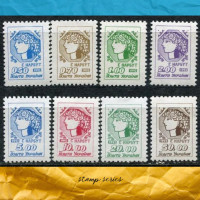
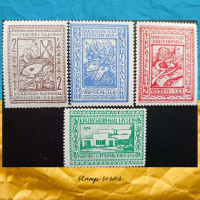
Up to 100 items of the first Ukrainian postage stamps postal block
Block "The first Ukrainian stamps of the liberation struggle in 1917-1921"The formation of an independent country raises the issue of developing symbols of statehood that are placed on official embl..
$2.70
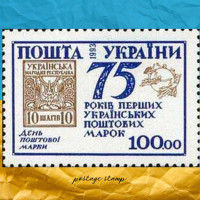
75 years of the first Ukrainian postage stamps
Postage stamp "75 years of the first Ukrainian stamps" 1993Ukraine has always strived for independence. The struggle for it lasted for centuries. For these reasons, the Ukrainian people are generall..
$0.40
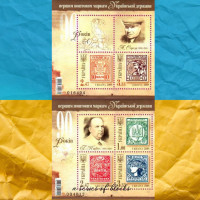
90 years of the first Ukrainian stamps series of blocks
90 years of the first Ukrainian stamps series of commemorative blocksOne of the signs of statehood is having its own postage stamp. While in the past, mail was the primary means of communication be..
$4.50
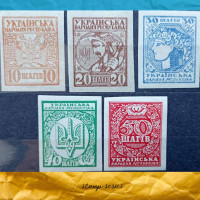
Shahy series of stamps
First stamps of Ukraine Shahy series of five stamps 1918Ukrainian philately dates back to the declaration of independence of the Ukrainian People's Republic. It was at the time of state-building th..
$5.50
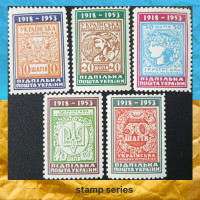
35 years of the first Ukrainian stamps PPU 1953 stamps series
Series of Stamps "35 Years of the First Ukrainian Stamps" by the Underground Post of Ukraine, 1953In 1953, the Underground Post of Ukraine released a commemorative stamp series to honor the 35th anniv..
$16.00
Related Articles
Armed formations of the Ukrainian revolution of 1917-1921. Series of Ukrposhta stamps.
The history of the Ukrainian people has always been connected with the struggle: for freedom, for independence, for equality of social conditions. Therefore, armed actions on the territory of modern..
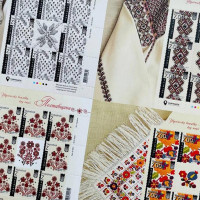
Nation code - stamps with embroidery of Ukrainian regions.
Fragment of the exposition of the Ivan Honchar Museum..
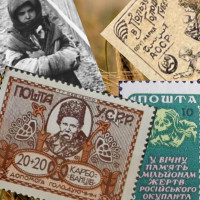
Postage stamps to aid the starving in the first half of the 20th century
Postage stamps to aid the starving in the first half of the 20th centuryWhat can be common in the history of the Ukrainian people today and 100 years ago? Human suffering in the south and east. But..
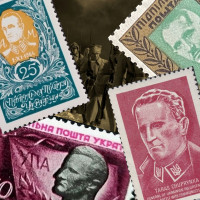
Heroes of Ukraine on the stamps of the Underground Post Office
The underground Post of Ukraine, as a unique phenomenon of Ukrainian history, became not just a means of communication, but also a way of expressing national resistance, striving for freedom and indep..

Coats of arms of cities, towns and villages of Ukraine are standard postage stamps.
Coats of Arms of Cities, Towns, and Villages of Ukraine Stamp Sheet 2024The stamp sheet "Coats of Arms of Cities, Towns, and Villages of Ukraine" for 2024 is like a journey through the country's symbo..
Ukrainian nesting dolls
Matryoshka motherlandIn the best traditions of the ancient Slavic spirit, in the very heart of the Ukrainian lands, the matryoshka was born - a magical wooden doll that became a real symbol of folk ar..
Philately as a hobby: history, importance and popularity
Philately is the science of collecting and researching postage stamps. It is an exciting industry that attracts hobbyists and professionals from all over the world. Philately allows you to study the h..