
Postage stamps to aid the starving in the first half of the 20th century
Postage stamps to aid the starving in
the first half of the 20th century
What can be common in the history of the
Ukrainian people today and 100 years ago? Human suffering in the south and
east. But if today Ukrainians are suffering from the pain of bullets and shells
of the russian government, in the 20s of the last century this crime was
carried out by the soviet government. Curiously, until 1923. The Ukrainian
People's Republic was independent of Soviet Russia until 1923, but this did not
prevent the Red Army from intervening.
The Bolsheviks exterminated Ukrainian
peasants in a no less humane way: by starvation. As a result, there were human
casualties in Kharkiv, Poltava, Dnipro, Zaporizhzhya, Donetsk, Mykolaiv, and
Odesa regions.
A historical sketch of the famine
tragedy
With the arrival of the Soviets on
Ukrainian lands and the formation of the Ukrainian Socialist Soviet Republic,
the then authorities could no longer resist the new government. This resulted
in a policy of forcible grain confiscation, including against the backdrop of
the drought and crop failure of 1920-1921. Grain was removed from Ukrainian
provinces by means of punitive and repressive measures under the supervision of
food detachments and regular troops.
This policy of overestimating grain
procurement plans and removing grain led to famine, which caused deaths and a
humanitarian catastrophe. The authorities tried to hide the fact of the famine
in every possible way. But when this became impossible, the main reason for
this was called drought. At the same time, measures were introduced under the
guise of work to overcome the disaster.
As a result of the criminal actions of
the Soviet government, the Ukrainian people lost more than one million people.
To this day, the exact number is unknown, and according to various estimates,
the figures are from 2 million people or more. But nothing goes unnoticed, and
all the crimes committed by the authorities cannot be completely concealed.
After all, there will always be people who care and stand for truth and
justice.
Coverage of the tragedy through
philately in Soviet times
In addition to the
political decisions of the time, there was a real drought that led to a
decrease in yields. As you know, philately covers all significant events of any
nature in its stamps. But this is not always possible due to the publicity of
such actions and strict political moderation. Therefore, the path to issuing
stamps that do not meet the requirements of political correction is quite
thorny or even impossible.
Stamps issued by the RSFSR
At that time, the natural disaster
affected not only the southern part of the Ukrainian lands, but also the Kuban
and the Volga region. The government cited this as the main cause of the famine
and couldn't sit idle. Therefore, as part of their concern, they created the
Central Commission to Combat Famine under the All-Russian Central Executive
Committee.
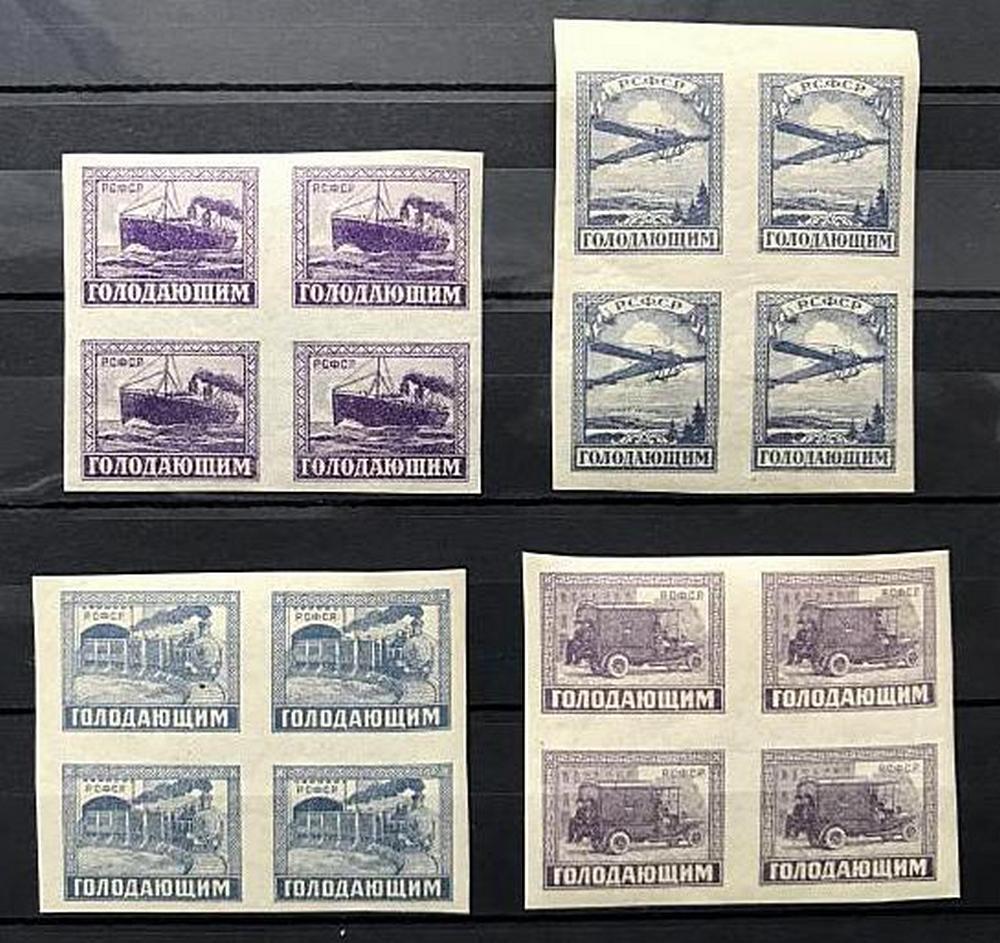
Among the actions taken to combat it was
the idea of issuing special postage stamps with a higher price, the proceeds
from which were to go to help the hungry. As a result, a series of stamps with
a face value of 2,250 rubles was issued, depicting barges with bread floating
on the Volga River. Stamps were issued in three colors (green, dark red, and
brown). The series also included a stamp featuring probably a soldier feeding a
peasant. Also, for charitable purposes, the stamp "Russia" was issued
with an overprint of "starving", which depicts a sword in his hand.
The stamps were issued in the following periods:
December 1921 "Helping the starving
of the Volga region";
February 1922 "R. S. F. S. R. to
the starving";
November 1922 "R. S. F. S. R. to
the Starving".
Also in February 1922, a separate series of 4 stamps was issued, which were in circulation only in the format of local issues in Rostov, Novocherkassk, and Millerovo. The stamps were titled "Southeast for the Starving". They were issued with images of peasants in triangular and rectangular formats in denominations of 2,000, 4,000, and 6,000.
Stamps issued by the USSR
As part of its expansion, the Soviet
government's main goal was to use Ukraine exclusively as a source of natural
resources, and the USSR was the last republic to issue stamps.
The reason for this was Moscow's
constant refusal to approve the printing. Nevertheless, the stamps were printed
abroad in Berlin in a million copies. It took a while to get permission to sell
them, and only in large cities for 20 days. These cities included Kyiv,
Kharkiv, Dnipro, Odesa, Poltava, and Chernihiv. After that, the remains were to
be destroyed. In April 1923, the authorities declared that the famine was over
and that there was no longer any need to help the starving.
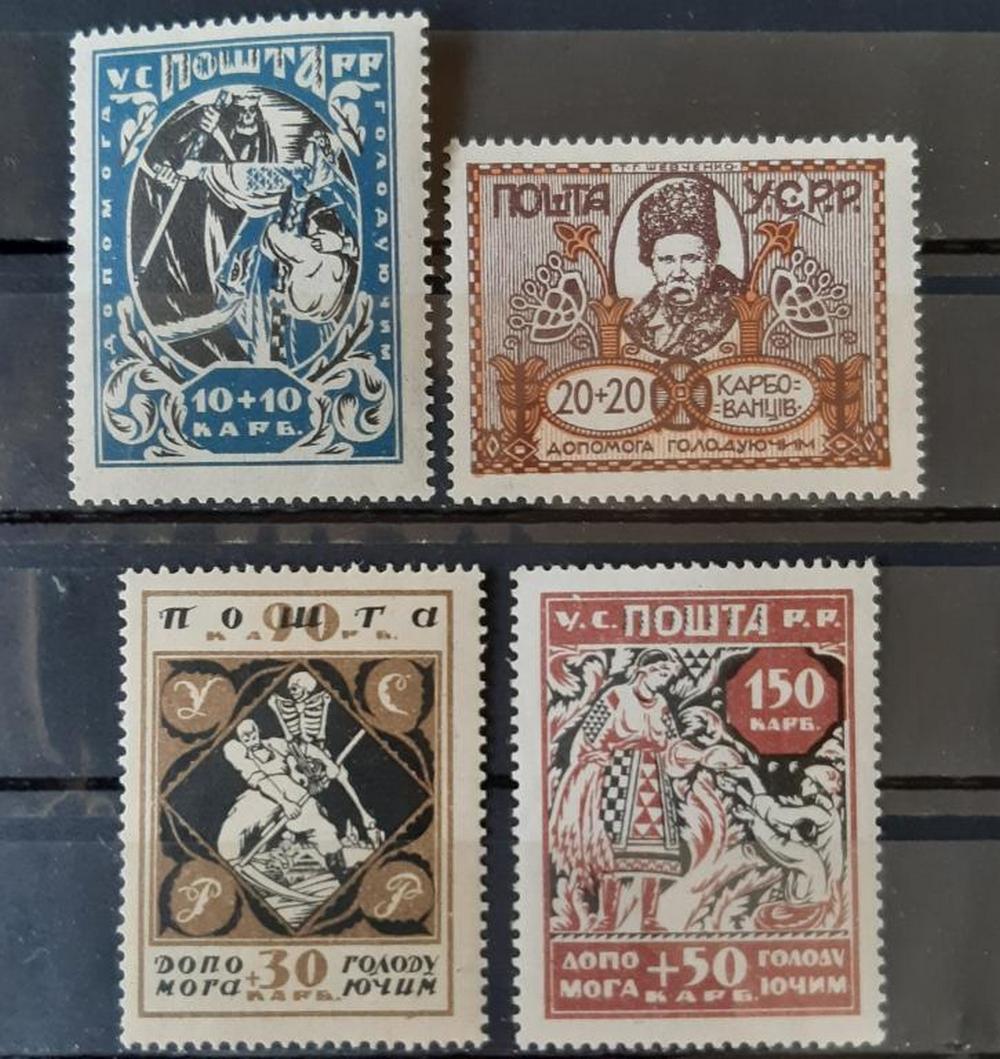
In total, the USSR Post Office issued
four variants of the charity stamps "Help for the Starving":
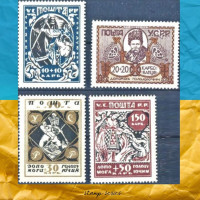
- The 10+10 karb denomination depicts a
woman in the center of the stamp embodying Ukraine. She protects a child by
warding off hunger.
- The 20+20 karb denomination features a
portrait of Taras Shevchenko in the center of the stamp, with an ear of wheat surrounding
it. This stamp is the first in the world to depict the writer.
- Face value 90+30 - the stamp depicts a
peasant taking a scythe from a skeleton. The image most likely represents the
farmers' struggle against death.
- 150+50 karb denomination - in the
center is a woman in national costume who represents Ukraine. In one hand she
holds a loaf of bread, which she gives to a peasant woman and her child. In the
other, she holds a sheaf of wheat.
The fact that Moscow prevented the stamps from being issued became known only after the collapse of the USSR. This is yet another confirmation of the signs of ethnic cleansing of the Ukrainian people.
Speculation on stamps dedicated to
famine
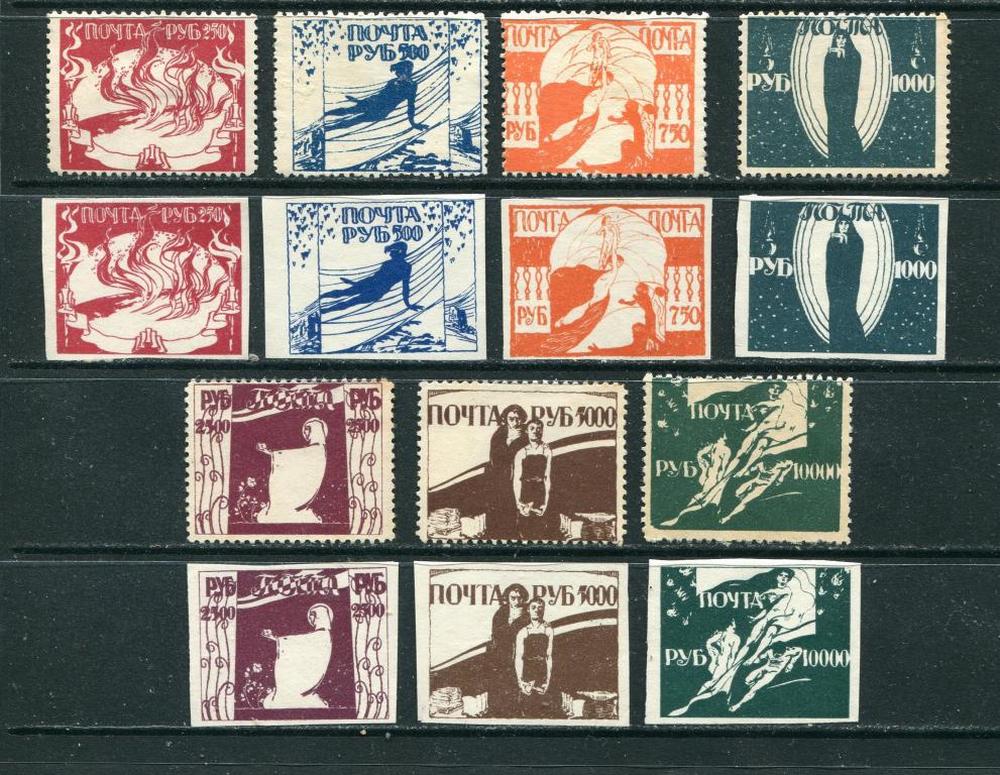
There is a series called "Odesa
issue of famine relief". It dates from 1919-1922 and consists of 7
different stamps. The series is classified as non-postal, and the stamps were
never put into circulation. They were printed and released for sale by the
Association of Italian Philately (Venice). There is no information about the
customer, distribution options, or the results of the proceeds from their sale
in favor of hunger relief.
It is difficult to say whether they are a fake or just an artistic fantasy. There is also a story that they were made by an Italian businessman, Marco Fontano, to deceive collectors. There is also information that the Pomgol public organization could have been a possible customer.
Coverage of famine on stamps of other
countries
In 1920-1921, in addition to the problem
of famine in the Ukrainian lands, this problem also occurred in Northern China.
Charity stamps were also used to counteract these circumstances. The Ministry
of Finance of the Republic of China issued a series "Assistance to Famine
Victims in China," which consisted of 8 stamps of different denominations.
There were also issues of non-postage
stamps for sale in the United States. Such series were issued periodically
within the framework of established funds to help the hungry. There are at
least three known sales campaigns to raise funds. The last of them took place
in 1929, after which the program was completely discontinued. Such stamps were
especially popular during the New Year holidays.
Related Products
75 Years of Ukrainian Postage Stamps souvenir Block
Souvenir Block of 75 Years of Ukrainian Postage StampsThe souvenir block is dedicated to the 75th anniversary of the issue of the first postage stamps of Ukraine. The souvenir was prepared for the 1..
$1.80
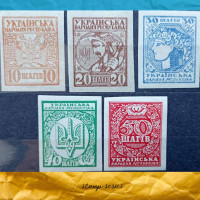
Shahy series of stamps
First stamps of Ukraine Shahy series of five stamps 1918Ukrainian philately dates back to the declaration of independence of the Ukrainian People's Republic. It was at the time of state-building th..
$5.50
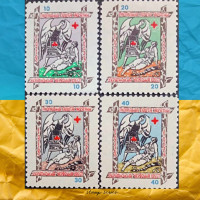
Red Cross stamp series Underground Post 1953
A commemorative series of stamps on the occasion of the 35th anniversary of the founding of UChH..
$12.00 $14.00
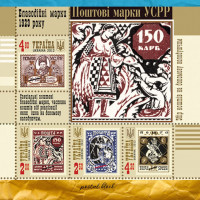
Postage stamps of the USSR, block of stamps
Postage stamps of the Ukrainian SSR, the block of stamps is dedicated to stamps issued by Ukrainian stamps to help the starving.Block of four stamps "Help to the starving"Postage stamps of Ukraine of ..
$2.00
Related Articles
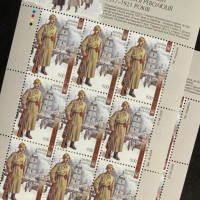
Armed formations of the Ukrainian revolution of 1917-1921. Series of Ukrposhta stamps.
The history of the Ukrainian people has always been connected with the struggle: for freedom, for independence, for equality of social conditions. Therefore, armed actions on the territory of modern..
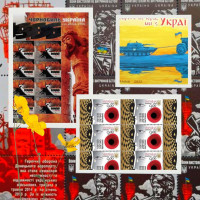
Tragedies of Ukrainians in Ukrainian philately
1918 or 1992 in the independent state can be considered as a year of formation of Ukrainian philately. During the 30-year period, many new stamps were issued on various subjects. Each new year signi..
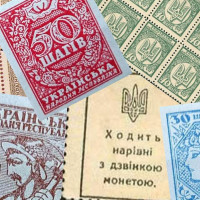
Shahs - the first Ukrainian stamps
ShahsThe Ukrainian state was formed in its first form after the events of the Bolshevik October Revolution. This happened through the proclamation of an autonomous republic within the Russian state ..